When asked how much a washing machine costs, laundry operators tend to quote the figure on the invoice. The real cost, however, becomes apparent over the years, spread across utility bills, detergent supplies and service interventions
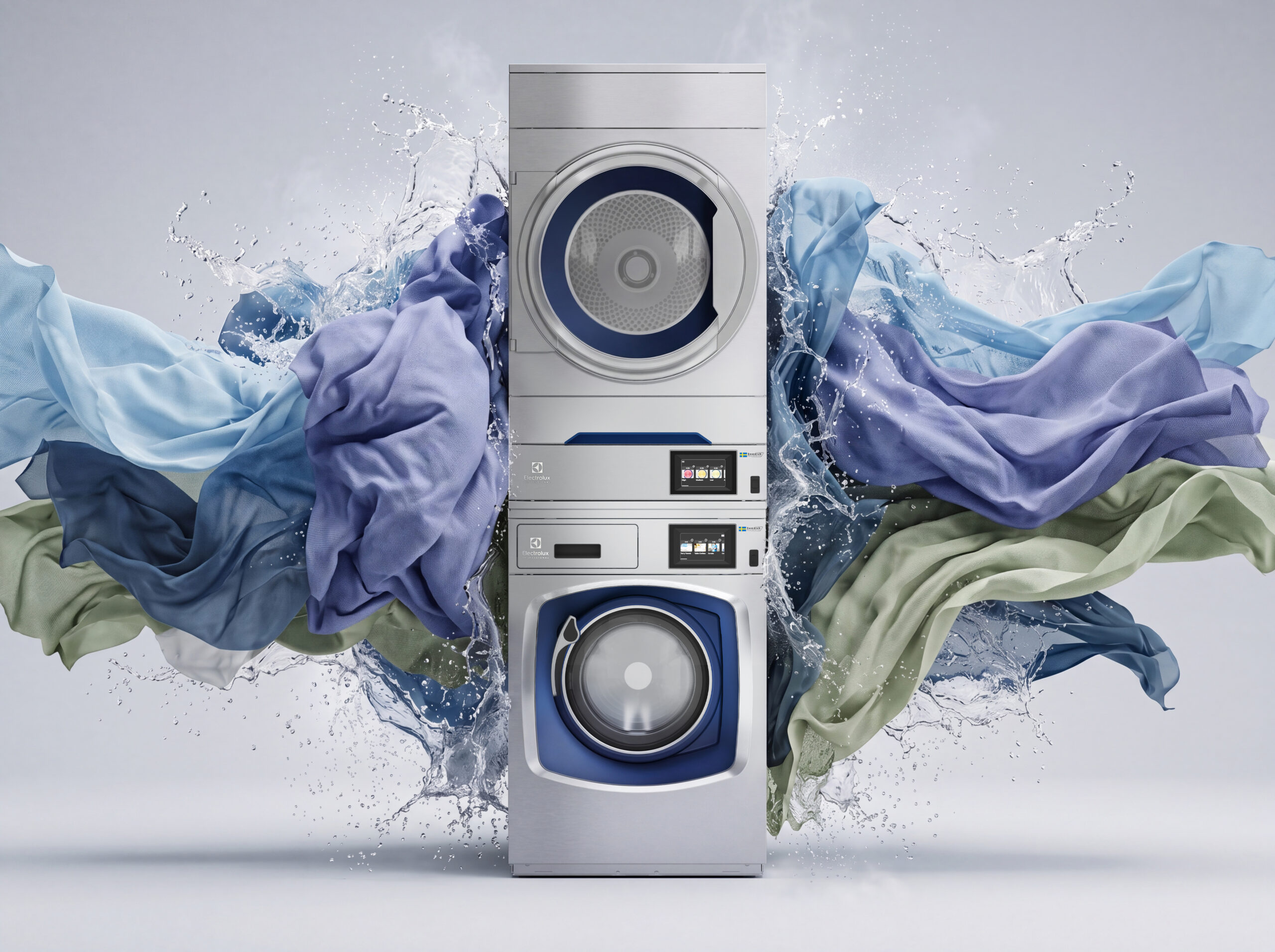
Electrolux Professional has calculated the proportions: the purchase price of a professional washing machine or tumble dryer accounts for approximately 10% of its total cost over its operational lifetime. The remaining 90% is water, energy and detergent, consumed cycle after cycle over a decade or more. This is the rationale behind Generation 7000, the new range of professional washing machines and tumble dryers making its debut with the Compact Power undercounter range, which the company is presenting at ExpoDetergo in Milan. The range is designed to tackle the costs that accumulate after purchase.
In brief:
- The purchase price accounts for approximately 10% of the total lifecycle cost of a professional machine, while operating costs account for the remaining 90%.
- According to the European Environment Agency, industry could reduce its water consumption by 30–50% using technologies already available on the market.
Why that 90% weighs more heavily in Europe
Operating costs are an area in which European operators have the least room for manoeuvre. This is also why efficiency can justify the investment. When it comes to energy, the differences between individual countries matter more than the European average. In the second half of 2025, an Irish business paid €25.52 per 100 kWh of electricity, compared with €7.48 in Finland: more than three times less for the same amount of electricity. Nor is the trend uniform: prices fell year on year in 18 EU Member States but rose in five, with Romania recording an increase of 15.4%.
A business can choose its equipment. It cannot choose the price of energy in the country where it operates.
Water management is another increasingly important lever for business competitiveness. For operations that use large quantities of water in their processes, such as professional laundries, reducing consumption means not only keeping operating costs under control but also improving the overall sustainability of their activities. According to the European Environment Agency, industry could reduce its water consumption by 30–50% using technologies already available on the market. This represents significant potential, particularly in light of the European Union’s target of improving water efficiency by at least 10% by 2030. For operators planning to replace their professional equipment over a ten-year horizon, the ability to optimise water and energy use is therefore a decisive factor when assessing an investment.
Where the costs lie
Three items account for most of the total: water, energy and detergent. Generation 7000 addresses each of them at a different stage of the washing cycle.
- Water consumption is reduced in two ways: the new drum design eliminates water that would otherwise remain in the machine without contributing to the washing process. Automatic load detection takes care of the rest: the machine identifies the actual laundry load and draws only the water required, rather than running the same programme for a full load and a half load.
- Energy is consumed during drying, but savings begin during washing: the faster the spin extraction, the less water remains in the textiles and the less moisture the tumble dryer needs to evaporate. Generation 7000 delivers extraction at up to 600G, the fastest extraction performance on the market. The most energy-intensive stage of the process therefore starts with drier textiles. During drying, heat-pump dryers can deliver energy savings of up to 65%, with a further 12% saving when a sensor detects that the drum is only half full. This is the first device of its kind in a professional tumble dryer.
- Detergent consumption follows the same principle: where the machine is equipped with dosing pumps, the quantity dispensed is calculated according to the actual load rather than a fixed setting.
Three ways of looking at the same machine
Electrolux Professional sums up this approach in three words: people, profit, planet. In a corporate brochure, they might seem like the usual vocabulary of sustainability. Applied to the cost of a machine, however, they describe three very specific dimensions.
- Profit is the dimension considered so far: that 90% and what happens when water, energy and detergent are matched to the actual load rather than to the selected programme.
- People is the dimension that does not appear on a utility bill. Professional laundry involves repetitive physical work, and fatigue can lead to absenteeism and staff turnover long before its effects are reflected in an equipment budget. All washing machines and tumble dryers in the Generation 7000 range are ErgoCert-certified, by the first internationally accredited body to certify the ergonomic characteristics of professional products. In other words, the machines have been tested with operators rather than simply validated in theory. Features include a loading height designed for repeated use, a handle that can be operated without excessive force, and a filter that can be accessed without bending down.
- Planet is the dimension that becomes apparent at the end of the machine’s lifecycle. The new drum is built with 60% fewer components, based on a modular architecture that the company has been using since 1999. Fewer components mean faster service interventions, less material to manufacture and transport, and a machine that can realistically be repaired or remanufactured rather than decommissioned. The range is designed for 40,000 cycles: the machine with the lowest environmental impact is almost always the one already installed.

«The professional laundry sector is undergoing a major transformation. Rising and volatile energy costs, growing attention to resource consumption and the need to improve productivity are compelling businesses to rethink their investment criteria. Assessing a machine’s purchase price alone is no longer sufficient: we need to consider the cost of operating it throughout its entire lifecycle. This is precisely the principle behind Generation 7000, a technology platform designed to reduce operating costs, improve working conditions and turn sustainability into a tangible economic advantage for our customers», said Francesco Maso, Interim President, Business Area Laundry.