According to the MECSPE Observatory, these companies are integrating sustainability into their business models, but around half are concerned about tariffs and 55% consider the new measures to be insufficient.
The manufacturing sector, with more than 486,000 active businesses [1] by the end of 2025, remains one of the pillars of the national economy and heads into 2026 with an overall stable outlook, albeit in a context marked by new competitive pressures. Against this backdrop, the manufacturing sector is holding its own thanks to an entrepreneurial spirit that is able to adapt and stay the course.
In the manufacturing sector, sustainability – increasingly viewed as a means of improving production efficiency as well as reducing environmental impact – has become a key component of Italian companies’ growth strategies.
Incentives alone are not enough to sustain growth
Despite the uncertainties surrounding the impact of tariffs – a concern for around half of businesses – and the assessment of the new measures set out in the 2026 Budget Law, which 55% consider insufficient, for companies it remains essential to be able to guide industrial decisions based on market priorities and to translate skills and technological innovation into competitiveness. In this context, incentives represent a possible form of support, but not the only lever for sustaining growth.
This is what clearly emerges from the MECSPE Observatory, produced in collaboration with Nomisma [2], which was presented at BolognaFiere at the opening of the 24th edition of MECSPE, the leading trade fair for manufacturing and industrial innovation.
According to the Observatory, which generally notes that nine out of ten companies report that their performance is in line with the targets set for the year, with a good level of satisfaction (around 30% express high or very high satisfaction), sustainability is considered an integral part of the business models of almost 90% of the companies in the sample.
It is primarily the foundry, additive manufacturing and aluminium sectors that are paying the most attention to this issue, which is less prevalent in the plastics and non-ferrous metals sectors.
Operations and resource management
How does this focus translate into concrete action? The measures implemented by companies mainly concern operations and resource management: six out of ten companies are optimizing their production processes (57%), whilst 44% are aiming to reduce their energy consumption.
A significant proportion – 37% – is also being channelled into waste reduction and material recovery, reflecting an approach that is increasingly focused on the efficient use of resources. Investments in more efficient machinery (34%) and in digitalisation for monitoring and controlling consumption (21%), however, remain more limited, although they are present.
It is no coincidence that some of the key trends in the manufacturing sector identified by the MECSPE Observatory relate specifically to the implementation of automation and robotics systems to boost production efficiency (39%), the adoption of environmentally friendly processes (24%) and the energy transition (23%). The path towards more sustainable manufacturing therefore involves choices that combine operational improvements, technological innovation and a focus on energy and materials.
Looking ahead to the two-year period 2026–2027, 56% of business owners express moderate confidence in the market outlook for their sector, whilst 26% express high or very high confidence, confirming the resilience of businesses and their ability to continue on their growth trajectory even in a changing landscape.
This approach is also reflected in operational assessments: 35% of companies consider their order book to be adequate or in excess of their production capacity and business objectives, whilst 30% regard it as stable.
The sector continues to focus on competitiveness and resilience, investing in efficiency, automation and digitalisation, and relying on the entrepreneurial ability to translate these choices into a tangible advantage, followed by structural transformations such as customisation, the energy transition and environmental sustainability.
Measures to support investment
In addition to these factors, in the third quarter of 2025, companies reported a number of critical issues that had the greatest impact on their operations: uncertainty surrounding the international environment, trends in raw material prices, and difficulties in recruiting staff – an issue that highlights the skills required to support growth.
Added to this scenario is the issue of the investment support measures introduced by the 2026 Budget Law, which come into effect following the conclusion of the Transition Plan 5.0 – a plan that has already received mixed reviews from business owners.
According to the previous survey by the MECSPE Observatory [3], almost half of entrepreneurs felt that the incentives were insufficient, whilst acknowledging their importance for innovation, or considered them wholly inadequate to support the sector.
Do you want to stay updated about the latest news of the manufacturing sector?Subscribe to the Click the Gear newsletter
The new measures for 2026, such as hyper-depreciation and the refinancing of Industry 4.0 incentives, are also viewed with caution: more than half of businesses consider them to be of little or no help in supporting their growth strategy.
In line with this picture, over half of entrepreneurs have not yet decided whether to make use of the available instruments, and only 1 in 5 plans to submit a request.
Among the main obstacles are failure to meet the necessary requirements and the complexity of the procedures, followed by the perception that these are not sufficiently tailored to the company’s needs.
In some cases, there is also a clear preference for investing without relying on public funds, reflecting an entrepreneurial approach that prioritises investment where necessary, even in the absence of extraordinary measures.
Outlook for export stability in the 2026–2027 period
On the international front, the issue of tariffs continues to have a tangible impact on business activity: more than half of companies report that they have already experienced or are currently experiencing an impact, with 2 in 10 business owners citing significant negative effects and 3 in 10 reporting a more limited impact.
It is no coincidence that around half of the sample say they are very or fairly concerned about the outlook for the business climate. This is in line with the recent analysis by the Confindustria Research Centre, which reports a decline in Italian exports in the fourth quarter of 2025 (–1.9%).
However, the MECSPE Observatory points to a stable outlook for exports in the two-year period 2026–2027: over half of companies expect conditions to remain stable, whilst around 28% anticipate growth.
Creating value in the new global landscape
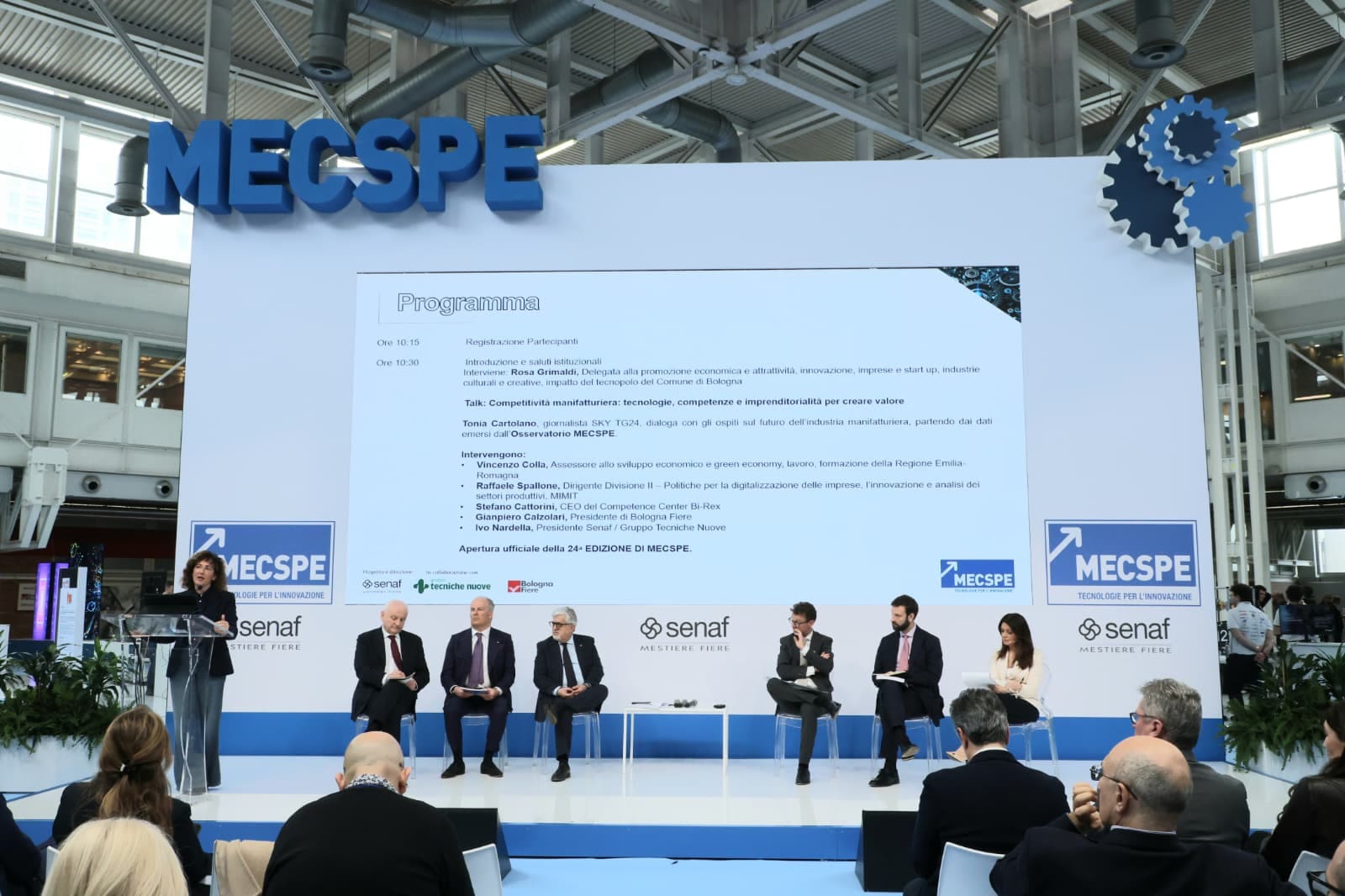
In this context, the opening conference of the 24th edition of MECSPE focused on manufacturing competitiveness, comparing institutions and companies on technologies, skills and entrepreneurship as levers for creating value in the new global landscape – going beyond mere financial incentives – and highlighting companies’ ability to translate innovation into tangible results.
The conference was attended by Rosa Grimaldi, Delegate for Economic Promotion and Attractiveness, Innovation, Business and Start-ups, and the Cultural and Creative Industries, and the Impact of the Bologna Municipal Tecnopolo, Vincenzo Colla, Vice-President and Councillor for Economic Development and the Green Economy, Employment and Training of the Emilia-Romagna Region; Raffaele Spallone, Head of Division II – Policies for the Digitalisation of Businesses, Innovation and Analysis of Productive Sectors at the Ministry of Enterprise and Made in Italy (MIMIT); Stefano Cattorini, CEO of the BI-REX Competence Centre; Gianpiero Calzolari, President of BolognaFiere; and Ivo Nardella, President of Senaf / Gruppo Tecniche Nuove.
The speeches
Raffaele Spallone
In a context marked by significant fragility in the international balance of power, where the pressure to increase competitiveness can place our manufacturing sector in serious difficulty, and at a time when the dual transition demands a radical transformation of our factories, industrial policy faces a complex challenge.
To address this challenge, MIMIT is undertaking a major overhaul of its policies. The white paper “Made in Italy 2030 – Toward a New Industrial Strategy”, presented by the Ministry of Enterprise and Made in Italy (MIMIT) in early 2026, serves as a strategic roadmap for strengthening the competitiveness of the Italian manufacturing sector by the end of the decade.
The document is a concrete action plan based on the rediscovery of manufacturing as a central pillar of the Italian economy. The Plan is built on three major transformations (“the threefold challenge”) and on the state resuming an active role to ensure energy independence, technological sovereignty, and economic security.
Vincenzo Colla
What is happening in the world is fuelling fear and uncertainty, whilst at the same time shaking the very foundations of international relations, the economy, politics and our values. Against this backdrop, where investments are at risk of suffering, we must take immediate steps to make our economic and social ecosystem increasingly resilient.
As the PNRR is coming to an end, it is essential to look to Europe and forge alliances to access future funding. As a Region, we will therefore continue to support investment by businesses and our supply chains in technological innovation and sustainability as competitive drivers for high-quality manufacturing.
It is no coincidence that we will soon be launching a call for proposals for certifications, just as we will continue to invest in training and skills. But first and foremost, we must focus on relationships: international ones, facilitating access to new markets, and domestic ones, which will enable the creation of innovative supply chain platforms.
From this perspective, MECSPE – a leading event for the manufacturing sector with an ever-growing number of exhibitors – represents a major international networking opportunity of great significance for the future of our industrial system.
Rosa Grimaldi
Data from the Observatory confirm that the Italian manufacturing sector is entering a phase of maturity: companies invest when the market demands it, carefully select their priorities and focus on technology and skills to create value.
In this context, Bologna is not only the home of MECSPE, but also an integrated ecosystem in which advanced manufacturing, the Tecnopolo, super computing, universities and technical colleges work together. Our commitment as a City Council is to strengthen this connection between research, businesses and talent, because competitiveness today stems from the ability to work as a system. MECSPE acts as a strategic accelerator: it brings together relationships, vision and opportunities, and strengthens the region’s international standing as a European hub for innovation applied to industry.
Stefano Cattorini
The picture emerging from the MECSPE Observatory confirms the resilience and robustness of the Italian manufacturing sector, even against the backdrop of an increasingly unstable and unpredictable international landscape from both a geopolitical and commercial perspective.
This is demonstrated by the stability of turnover, the order book and satisfaction levels, which are broadly in line with 2024. Despite legitimate concerns regarding tariffs, exports continue to be a cornerstone of national competitiveness, confirming the strength of Italian supply chains in foreign markets.
At a time when the industrial sector is calling for stability, it is essential to boost competitiveness by supporting innovation, technological investment and skills: our Competence Centre, which has played a crucial role in implementing policies linked to the PNRR, will continue to serve as a point of reference for businesses that view digitalisation, automation, continuous training and technology transfer as levers for efficiency and drivers of growth and development.
Gianpiero Calzolari
MECSPE reaffirms BolognaFiere’s role as a strategic platform serving the Italian manufacturing industry. In an international context marked by new competitive pressures and a complex geopolitical landscape, businesses are demonstrating that entrepreneurial capability remains the decisive factor: investing in technology, skills and supply chains, rather than relying solely on financial incentives.
MECSPE is the place where innovation meets the market and where the industrial sector can bring together vision, local context and competitiveness. BolognaFiere works to ensure that this ‘home of manufacturing’ becomes more international, more connected and more focused on the tangible growth of businesses with each passing year.
Ivo Nardella
Italian manufacturing is undergoing a period of profound transformation, in which technological innovation and the international landscape are reshaping the rules of competitiveness. Against this backdrop, investment support schemes remain important, but they cannot be the only lever: we need an industry capable of standing on its own two feet, investing because technology creates real value and improves processes.
This is precisely the objective that MECSPE focuses on, offering businesses a venue where they can view practical solutions, engage with the supply chain and translate innovation into business-driven industrial decisions. MECSPE thus reaffirms its role as a strategic platform for enhancing productivity, quality and expertise within the manufacturing sector.
1Movimprese data for 2025 – Manufacturing industry.
2 MECSPE Observatory on the manufacturing industry for the third quarter of 2025, conducted by Nomisma on a sample of 391 Italian manufacturing companies using the CAWI (Computer-Assisted Web Interviewing) method, carried out in January–February 2026.
3 MECSPE Observatory on the manufacturing industry for the second quarter of 2025, conducted by Nomisma on a sample of 350 Italian manufacturing companies using the CAWI (Computer Assisted Web Interviewing) method, carried out in October–November 2025.
4 Confindustria Research Centre: Flash Economic Survey, February 2026.