Article by Dario Gozzi
For the household appliance industry, automation represents a strategic lever to maintain competitiveness. To work better, machines must be able to communicate to allow increasingly controlled processes and be able to return a quantity of data suitable for tracking the products and what happens in production. IO-Link is an important global communication standard, open and standardized according to the IEC 61131-9 standard, suitable for the intelligent connection of sensors and actuators with industrial automation systems. It features digital signals and is bidirectional with point-to-point connection. IO-Link is the ideal system for quick and easy integration of all signal types, including the ability to create a direct digital connection to the cloud. It guarantees a common technological platform for the development and use of sensors and actuators capable of exchanging data, automating and optimizing industrial processes.
IO-Link is not yet another fieldbus
IO-Link is not yet another fieldbus, it is not a traditional fieldbus, but a dedicated digital connection between an IO-Link Master and a device (sensor or actuator). In practice it is a point-to-point communication protocol between a compatible IO system and a field device, which is based on an open standard, in which the devices can be integrated into any fieldbus or automation system.
IO-Link offers numerous advantages: first and foremost the simplified wiring (less connection complexity) uses common unshielded 3-wire cables (up to 20 meters long), drastically reducing installation costs and complexity. It offers great data availability: with remote configuration and monitoring it allows not only to read signals, but also to send parameters to sensors and receive detailed diagnostic data, with advanced diagnostic functionality.
Being an open and non-proprietary protocol, it means that devices from different manufacturers can communicate with the same master, therefore it allows for simple device replacement.
Through a single cable, IO-Link manages three types of data simultaneously:
- process data with real-time information,
- service data containing configuration parameters that can be changed remotely, such as a sensor threshold,
- error or diagnostic messages from the production line (for example, an engine overheating).
It features advanced diagnostics, enabling predictive maintenance by identifying problems as they arise, before they cause machine downtime.
Unlike traditional analog systems, it transmits not only the measured value (such as temperature), but also configuration parameters and advanced diagnostic information. For example, in the event of a fault, the Master can automatically send the correct configuration to the new sensor, eliminating the need for manual calibration. Last but not least, it uses digital signals rather than analog, avoiding electromagnetic interference and the loss of precision typical of 4-20mA signals.
Main industrial applications
IO-Link supports factory automation and smart factories as a cornerstone of Industry 4.0. It is used to monitor the status of motors, conveyor belts, and valves in real time, allowing production processes to be adjusted based on actual data collected from the field. Thanks to continuous diagnostics, IO-Link sensors can report abnormal vibrations or excessive dirt on various parts before a failure occurs.
It also benefits spare parts management (Auto-Device Replacement). If a sensor fails, the master device recognizes the new device and automatically sends the correct configuration parameters. This allows for “plug-and-play” replacement without the need for manual programming tools.
In logistics and intralogistics, it is used to integrate RFID readers and position sensors into complex sorting systems, ensuring precise goods traceability and seamless warehouse control. Furthermore, the IO-Link Wireless extension is essential for moving components or robotic arms where physical cables would be subject to wear or limit freedom of movement.
Its application is becoming crucial in the food and pharmaceutical sectors as it offers the possibility of using standard unshielded cables (M12/M8), which are easy to clean and durable, while ensuring digital precision in filling and packaging processes.
As for data, it allows access from the sensor level to the cloud and ERP via protocols such as MQTT or OPC UA.
MQTT is an extremely lightweight messaging protocol based on the publish-subscribe model (asynchronous messaging paradigm). It is specifically designed for machine-to-machine communications and IoT, where devices often have limited resources (battery, memory) and operate on low-bandwidth or unreliable networks.
Similarly, OPC UA is a standardized industrial communications protocol used for the secure exchange of data between machines, sensors, and management systems. It is considered the universal language of Industry 4.0 and the IIoT because it allows devices from different manufacturers to communicate seamlessly with each other.
Constant support to keep up with the latest technological developments
The benefits that the use of IO-Link can guarantee for data management and for setting up lean systems in the name of simplicity are undeniable, with full advantage of a production where increasingly punctual and precise control and detection needs are essential.
In particular, it is essential for manufacturers to be able to count on a partner who offers them constant support to keep up with the latest technological developments and with the wide possibilities that IO-Link offers. Murrelektronik boasts long experience in offering technologically advanced products and constantly makes its know-how available thanks to a program to spread technological culture in companies.
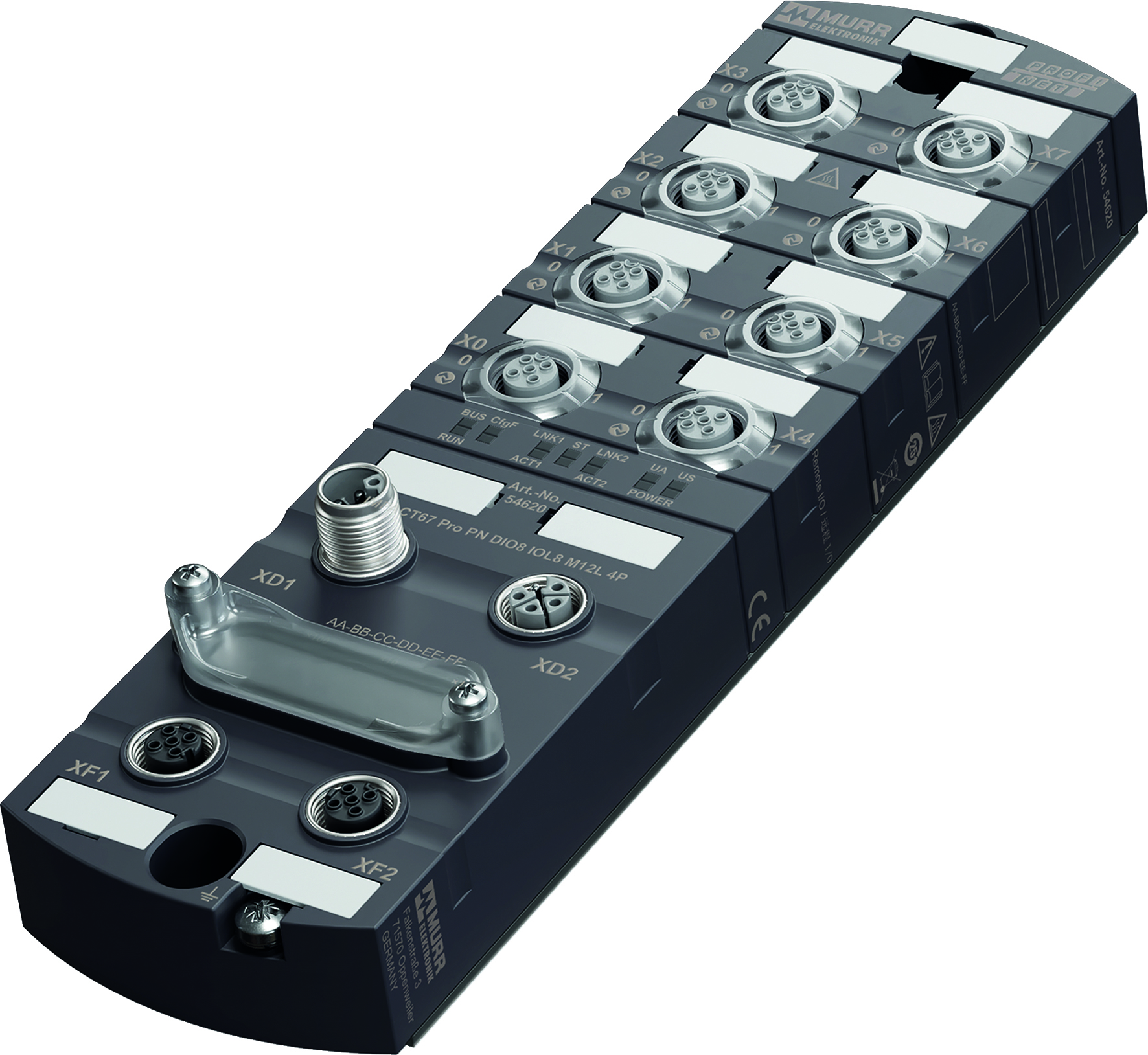
The company, based in Vimercate, provides everything needed to network the controller with sensor and actuator level devices via IO-Link, creating connections with decentralized components, most of the time without the need for electrical cabinets. All this can be achieved both in the design of a new line and on systems to be modernized, with solutions that bring signals, data and power close to the process.
Starting from the master modules, hubs, converters and various devices up to the cabling, everything is coordinated and contributes to the optimal functioning of different applications. In detail, the pre-configured devices ensure quick and easy start-up, without the need to import an IODD (IO Device Description) or use a configuration tool. The self-configuration mode automatically detects the connection of inputs and outputs for immediate reading/writing of process data.
In modern industrial automation, characterized by increasingly decentralized architectures, the daily challenge is to optimize installation times and maintain full control over the system: pure.IO is the new generation of IO-Link master created to meet these needs.
pure.IO: less wiring, more control
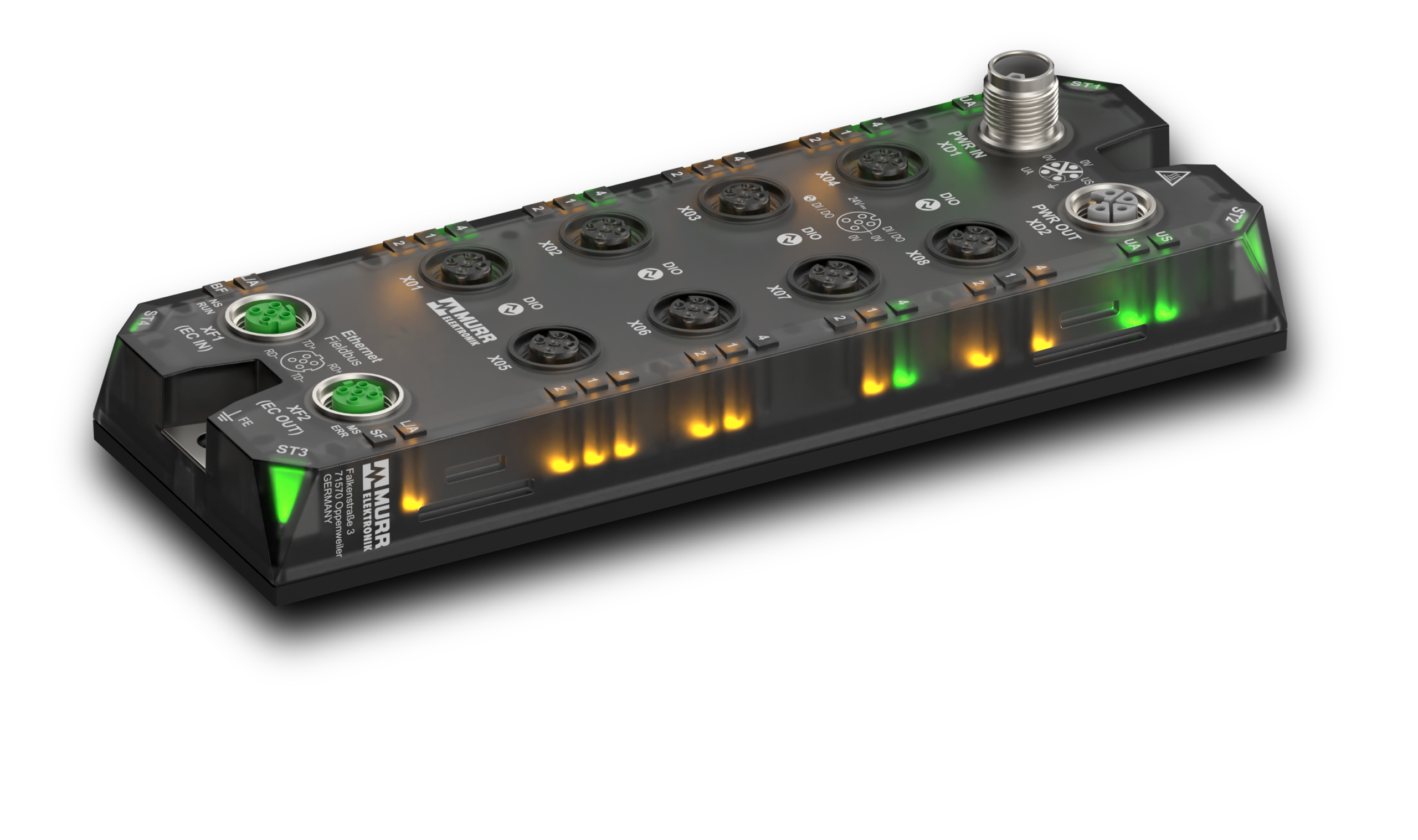
Thanks to a plug & play approach and an ultra-compact design, pure.IO drastically simplifies cabling and integration into major industrial environments, even in small spaces. The result is efficient management of I/O, power and communication, supported by immediate in-field diagnostics for maximum visibility of system status.
Thanks to the extended daisy-chain (IO-Link, power and fieldbus), it is possible to significantly reduce the number of connections needed, which translates into quick installations, low operating costs and greater flexibility in plant design.
Built-in diagnostics allow you to quickly identify system status: pure.IO uses corner LEDs for 360° visibility and single-port indicators for clear, instant monitoring.
With up to 256 I/Os per master and multi-protocol support (PROFINET, EtherNet/IP, EtherCAT), pure.IO adapts to different architectures and plant requirements.
The light and compact design also makes it particularly suitable for installations on moving parts. The connection length is up to 40 m thanks to the IO-Link expansion port.
Standardized processes help manage the growing complexity of the production world and react quickly to changing customer needs and market demands. But they also have a further advantage: they form the basis of digital transformation. Redefining the development, planning, installation and production processes on digital platforms would be inconceivable without standardization. The pure.IO modules are the tool for implementing the standardization of the different types of machines, they are the link that connects all the elements to each other.